



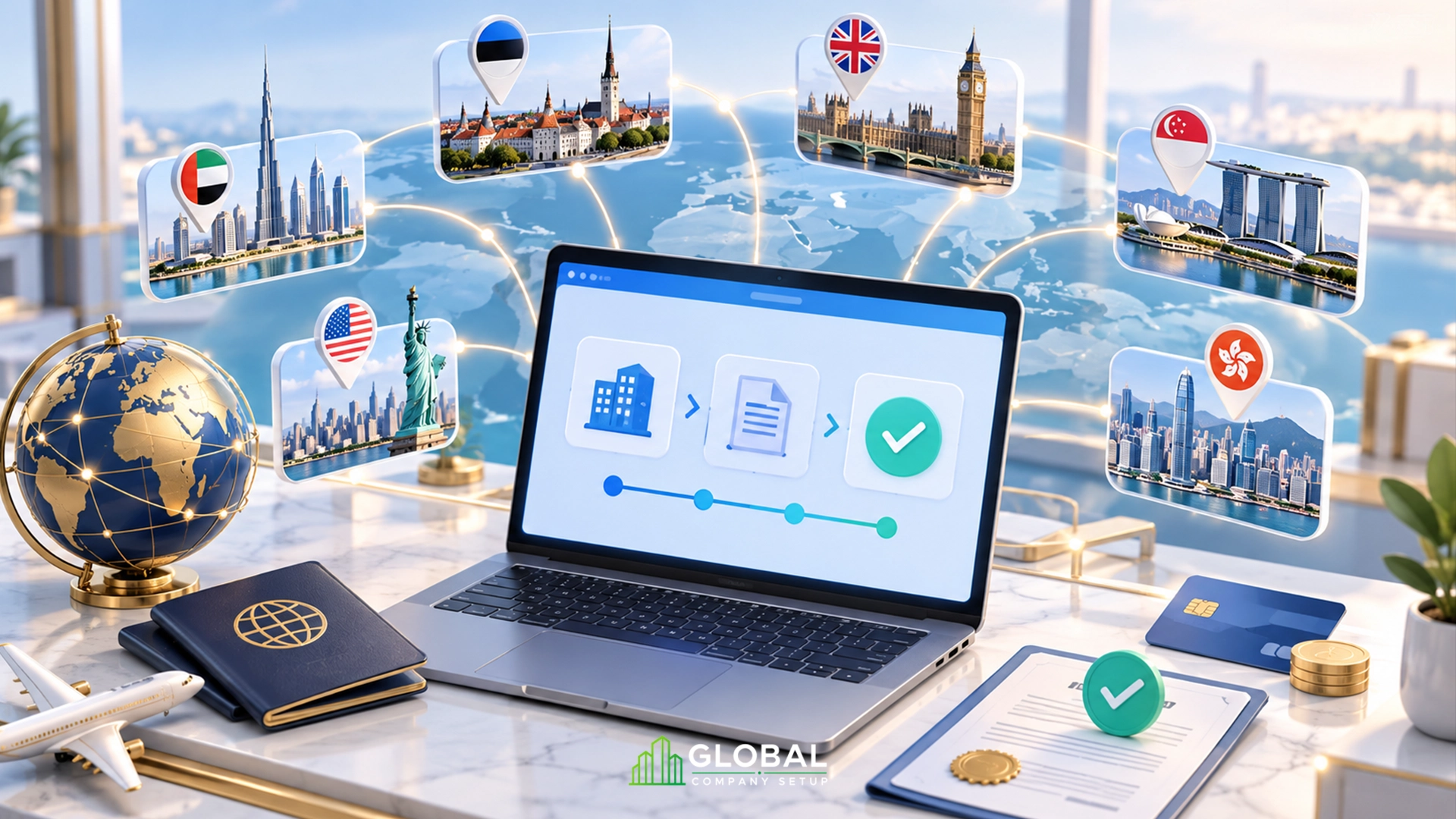
Guide to Setting Up a Company Abroad for E-Commerce
The rapid growth of digital commerce has enabled businesses to reach consumers around the world rather than limiting their operations to customers in their home countries. Today, entrepreneurs can engage in cross-border trade through their own e-commerce websites, international marketplaces, and digital sales platforms. However, one of the most important decisions facing businesses seeking to expand internationally is determining where to establish their company and which legal structure to operate under.
In this context, setting up a company abroad for e-commerce has become a strategic option worth considering for entrepreneurs looking to operate in global markets. Establishing a company overseas may create opportunities to enter into agreements with international customers, apply for certain payment processing services, conduct transactions in multiple currencies, and organize commercial operations more efficiently.
Nevertheless, owning a foreign company involves much more than obtaining a certificate of incorporation. Tax obligations, business bank accounts, payment provider verification procedures, accounting requirements, and the laws of the countries in which the business operates must all be carefully considered.
For entrepreneurs planning to sell through platforms such as Amazon, Etsy, Shopify, and similar services, selecting the appropriate corporate structure is an important step toward building a sustainable business model.
In this comprehensive guide prepared for Offshore Şirket Kuruluşu, we examine the process of establishing an overseas company for e-commerce, including country selection, incorporation procedures, costs, taxation, payment systems, and common mistakes to avoid.
What Does Setting Up a Company Abroad for E-Commerce Mean?
Setting up a company abroad for e-commerce refers to the process by which an entrepreneur establishes a legally registered business entity outside their country of residence to conduct online sales of goods or services.
The company is incorporated in accordance with the laws of its country of registration and may be subject to various registration, reporting, and tax obligations depending on the nature of its activities.
Foreign companies can be used for various business models, including physical product sales, digital product distribution, subscription services, software sales, international consulting, and cross-border service delivery.
However, incorporating a company overseas does not necessarily mean that its business activities take place exclusively in the country of incorporation.

For example, an entrepreneur living in Türkiye may establish a company in the United Kingdom and sell products or services to customers in different countries. In this situation, the company’s obligations in the United Kingdom must be considered alongside any tax responsibilities that may arise from managing the business from Türkiye.
Therefore, incorporating a company abroad should be planned by considering not only the country where the business is registered but also where it is managed, where its products are stored, and where its customers are located.
Why Establish a Company Abroad for E-Commerce?
Businesses seeking international expansion may choose to establish overseas companies for various commercial reasons.
These motivations range from accessing payment processing solutions to meeting customer expectations in target markets.
1. Access to International Markets
One of the main reasons for establishing a company abroad is to create a business structure suited to specific target markets.
Entrepreneurs planning to operate in major markets such as Europe, the United Kingdom, and the United States may evaluate the operational benefits of incorporating a company in those jurisdictions.
In certain situations, having a locally registered company may make it easier to establish commercial relationships with suppliers, logistics providers, and business partners.
However, registering a company in a particular country does not automatically grant every license or authorization required to conduct business in that market.
2. Eligibility to Apply for International Payment Systems
Payment processing is one of the most important components of e-commerce operations.
To allow customers to make purchases using credit cards or other digital payment methods, businesses must work with an appropriate payment service provider.
Some international payment providers, such as Stripe, offer their services to businesses registered in selected countries.
For this reason, entrepreneurs considering setting up a company abroad for e-commerce should review the eligibility requirements of their preferred payment service providers before deciding where to incorporate.
However, establishing a company in a supported country does not guarantee approval for a payment processing account.
During the application process, providers may need to verify incorporation documents, tax identification numbers, operating addresses, bank account information, and beneficial ownership details.
3. Conducting Business in Multiple Currencies
In international e-commerce, customers may prefer to make payments in different currencies.
Accepting payments in US dollars, euros, or British pounds can influence a company’s financial planning and cash flow management.
Depending on the banking and payment services available, businesses may be able to accept payments or maintain accounts in multiple currencies.
However, access to these services depends on the company’s jurisdiction of incorporation and the policies of the financial service provider.
Currency conversion fees, transfer charges, and payment processing commissions should also be included when calculating the total cost of business operations.
4. International Brand Positioning
For some businesses, operating through a company registered in their target market may help strengthen commercial relationships.
Entrepreneurs working with corporate customers or seeking to enter international supply chains may benefit from structuring their business in line with long-term expansion objectives.
However, a trustworthy brand reputation does not depend solely on the country in which a company is incorporated.
Customer service, product quality, delivery performance, transparent return policies, and accurate business information also play essential roles in establishing customer confidence.
5. Building a Business Structure That Supports Growth
E-commerce operations may begin on a relatively small scale. However, as sales increase, accounting, logistics, customer relationships, and financial management can become increasingly complex.
Choosing the right company structure may make it easier to plan for future developments, such as introducing business partners, attracting investment, or entering new markets.
Therefore, company formation decisions should take into account not only immediate operational needs but also medium- and long-term growth objectives.
Best Countries to Consider for Establishing an E-Commerce Company Abroad
One of the most significant decisions in setting up a company abroad for e-commerce is choosing the jurisdiction in which the business will be incorporated.
Every country has its own incorporation procedures, taxation system, accounting requirements, and rules governing access to financial services.
Consequently, no single jurisdiction can be considered the best option for every entrepreneur.
Establishing an E-Commerce Company in the United States
The United States is frequently considered by e-commerce entrepreneurs because of its large consumer market and highly developed digital commerce ecosystem.
For entrepreneurs considering US incorporation, the Limited Liability Company (LLC) is one of the business structures worth evaluating.
An LLC is a business entity established under state law that can provide limited liability protection to its owners under certain conditions.
However, its treatment for federal tax purposes depends on factors such as the number of owners and any applicable tax elections.
Important considerations when establishing an e-commerce company in the United States include:
- The state in which the company will be formed.
- Ownership and management arrangements.
- Federal and state tax obligations.
- Registered Agent services.
- Obtaining an Employer Identification Number (EIN).
- Annual filings and reporting requirements.
- Sales tax and economic nexus rules.
- Banking and payment provider eligibility requirements.
Certain federal reporting obligations may arise, particularly for businesses owned by individuals residing outside the United States.
Therefore, low incorporation costs do not necessarily mean that a company’s overall tax and compliance expenses will also be low.
Establishing an E-Commerce Company in the United Kingdom
The United Kingdom is another jurisdiction entrepreneurs frequently consider because of its established company structures and international business environment.
One of the most commonly used business structures is the Private Limited Company, commonly referred to as a Ltd company.
Company formation and registration in the United Kingdom are administered through Companies House.
Establishing a company requires preparing an appropriate business name, registered office address, director information, and other necessary registration details.
Identity verification requirements may also apply to company directors and other relevant individuals.
Companies registered in the United Kingdom must keep track of obligations such as annual accounts, confirmation statements, corporation tax returns, and VAT requirements where applicable.
Establishing a UK company may be an option for businesses planning to sell through Amazon UK or directly to British consumers.
However, having a UK-registered company does not automatically guarantee approval for a marketplace seller account or a business bank account.
Establishing an E-Commerce Company in Estonia
Estonia is recognized for its digital public services and electronic business administration infrastructure.
The country’s e-Residency program provides eligible applicants with access to certain Estonian digital services.
Under appropriate conditions, the e-Residency system allows entrepreneurs to complete company formation and management procedures online.
This feature may provide operational convenience for certain entrepreneurs offering digital services or operating internationally.
However, e-Residency does not provide physical residence rights or automatically establish personal tax residency.
Similarly, incorporating a company in Estonia does not mean that the business will have no tax obligations in other countries.
Additional tax considerations may arise if the company is effectively managed from another jurisdiction.
Entrepreneurs planning to establish an e-commerce business in Estonia should evaluate company registration expenses, registered address and contact person requirements, accounting obligations, and European Union VAT rules together.
Establishing an E-Commerce Company in the United Arab Emirates
The United Arab Emirates is another jurisdiction that may be considered for international trade and access to regional markets.
Business incorporation options are available across different emirates and free zones.
However, licensing requirements, permitted activities, physical presence obligations, and access to financial services can vary.
The widespread assumption that all companies in the United Arab Emirates are exempt from taxation is incorrect.
Corporate tax, VAT, eligibility requirements, and other legal obligations must be evaluated according to the company’s business model.
For this reason, entrepreneurs should consider their actual operational requirements rather than selecting a jurisdiction based solely on expectations of tax advantages.
Which Country Should You Choose for Your E-Commerce Company?
When selecting a country, entrepreneurs should evaluate both their sales model and their target market.
For example, a business intending to sell products primarily to customers in the United States may investigate US incorporation.
An entrepreneur providing digital services to European customers may consider Estonia and its digital business administration facilities.
A business planning to focus heavily on customers in the United Kingdom may examine the commercial and operational implications of establishing a UK company.
However, these examples should not be interpreted as definitive recommendations.
The most suitable decision requires examining where products will be stored, where customers are located, where the business will be managed, and what requirements apply to the intended payment infrastructure.
How to Set Up a Company Abroad for E-Commerce: 7 Essential Steps
The process of setting up a company abroad for e-commerce involves several important stages. Careful planning can help reduce delays and unexpected expenses after incorporation.
1. Define Your Business Model and Target Market
First, determine which products or services your business will offer.
Selling physical goods, digital products, subscription services, or software may create different operational requirements.
You should also identify where your customers will be located, where products will be shipped from, and how returns will be handled.
2. Choose the Country of Incorporation
Once you have defined your target market, compare the incorporation requirements of different jurisdictions.
This evaluation should consider not only initial registration fees but also annual accounting costs, taxes, licenses, and banking procedures.
3. Select the Appropriate Company Structure
The type of company you establish may affect the responsibilities of its owners, its management arrangements, and certain tax obligations.
For example, a US LLC and a UK Ltd company do not have identical legal or tax characteristics.
Therefore, it is important to review the applicable legislation before selecting a company structure.
4. Prepare the Required Documents
The documents required for foreign company formation vary by jurisdiction and service provider.
Common requirements include identity verification, address information, the proposed company name, a description of business activities, and ownership details.
Some countries may also require additional identity checks or beneficial ownership disclosures.
5. Complete the Company Registration Process
After preparing the necessary documents, the formal incorporation process can begin.
Applications may be submitted electronically in certain countries, while other jurisdictions may require additional documentation or local representation.
Once the company is incorporated, the relevant registration documents and official identification numbers can be obtained.
6. Apply for Business Banking and Payment Processing
After incorporation, the company may apply for an appropriate business bank account or financial service provider.
During this stage, applicants may need to explain their business activities, submit incorporation documents, and verify the identity of beneficial owners.
Payment providers may also evaluate the content of the e-commerce website, the products being sold, return policies, and the country in which the business operates.
7. Plan Accounting, Taxation, and E-Commerce Operations
Incorporating a company does not eliminate ongoing legal obligations.
Instead, regular bookkeeping, required tax filings, annual reporting, and compliance responsibilities begin after formation.
These processes should be planned from the outset to support sustainable e-commerce operations.
Documents Required to Establish an E-Commerce Company Abroad
The documents required when setting up a company abroad for e-commerce depend on the chosen jurisdiction and legal structure.
Commonly requested documents and information may include:
- A valid passport or another accepted identification document.
- Residential address details and proof of address where required.
- The proposed legal company name.
- Information describing the company’s business activities.
- Identification details of shareholders and directors.
- Information about ultimate beneficial owners.
- Registered office or representative details where applicable.
- An explanation of the business model and source of funds in certain circumstances.
Because documentation requirements vary between countries, entrepreneurs should verify the latest official requirements before applying.
It is also important to remember that banks may request additional documents beyond those required for company incorporation.
How Much Does It Cost to Set Up an E-Commerce Company Abroad?
Company formation costs are among the most frequently researched subjects for entrepreneurs considering international incorporation.
However, comparing every jurisdiction using a single estimated figure would be misleading.
Total costs vary according to the country of incorporation and the services selected.
Company Registration Fees
Official registration fees may be payable to the relevant government authority during incorporation.
Additional expenses may arise for professional formation services or document preparation assistance.
Registered Address and Representative Costs
Some company structures require a registered office address or a local representative.
The annual cost of these services depends on the jurisdiction and service provider.
Accounting and Tax Advisory Services
Accounting and tax advisory expenses should be treated as important components of a company’s annual operating budget.
Tax obligations may become more complex when a business conducts transactions in multiple countries.
Banking and Payment Processing Fees
Banking and payment services may involve account maintenance charges, transaction commissions, and foreign exchange conversion fees.

Depending on sales volume, these expenses can affect the total cost of running the business.
Annual Renewal and Reporting Expenses
Some jurisdictions impose annual registration renewals, confirmation statements, or other reporting obligations.
Failure to meet these requirements on time may result in financial penalties or problems with the company’s registration status.
Therefore, when calculating incorporation costs, entrepreneurs should budget not only for initial expenses but also for at least one year of operational and compliance requirements.
How Are E-Commerce Companies Established Abroad Taxed?
For entrepreneurs planning to establish a company overseas, taxation is one of the most important areas requiring careful consideration.
The country in which a company is registered plays a significant role in determining its tax obligations. However, it is not always the only relevant factor.
Where the company is effectively managed, where its income is generated, where products are stored, and whether a taxable presence exists in other jurisdictions may also affect its tax responsibilities.
Corporate Income Tax
Corporate income tax is one of the primary taxes that may apply to a company’s profits.
Tax rates and methods of taxation differ between countries.
Certain jurisdictions may offer specific tax arrangements or incentives, subject to eligibility conditions.
However, businesses must meet the requirements established by the relevant legislation to benefit from these arrangements.
VAT and Sales Taxes
In international e-commerce, Value Added Tax (VAT) and sales tax obligations may vary depending on the type of product, delivery destination, and country in which the transaction takes place.
Certain transactions within the European Union are subject to different tax systems from those applicable to state-level sales taxes in the United States.
Therefore, companies selling through international marketplaces should evaluate tax registration requirements in the countries where they conduct business.
Tax Considerations for Entrepreneurs Living in Türkiye
Establishing a company abroad while residing in Türkiye does not automatically eliminate personal or business-related tax obligations in Türkiye.
Factors such as the company’s place of effective management, business activities, ownership structure, and the nature of its income must be considered.
Double taxation agreements and applicable domestic tax legislation may also be relevant to foreign company structures.
Therefore, entrepreneurs living in Türkiye and considering setting up a company abroad for e-commerce should carefully review both the regulations of the incorporation jurisdiction and their potential obligations in Türkiye.
Rather than making decisions based solely on general tax information, obtaining advice from a qualified professional specializing in international taxation is recommended.
Setting Up a Company Abroad for Shopify, Amazon, and Etsy
The platform through which an e-commerce business intends to operate may play an important role in determining its corporate structure.
Establishing a Company for Shopify
Shopify is an e-commerce platform that enables businesses to create and manage their own online stores.
Using Shopify does not necessarily require establishing a company abroad.
However, entrepreneurs may evaluate different corporate structures based on their target markets and preferred payment processing services.
When choosing a payment solution, the company’s country of registration, banking information, and the verification requirements of the relevant service provider should be considered.
Establishing a Company for Amazon
Businesses planning to sell on Amazon should review the seller registration requirements of their target marketplace before proceeding with company incorporation.
Amazon marketplaces in different countries may impose different requirements regarding identity verification, tax information, and business documentation.
Establishing a foreign company may be appropriate for certain businesses. However, entrepreneurs should not assume that incorporating abroad is always necessary to sell on Amazon.
In addition, fulfillment and warehousing models such as Fulfillment by Amazon (FBA) may create additional tax obligations in jurisdictions where inventory is stored.
Establishing a Company for Etsy
Etsy is widely used by sellers offering handmade products, design-oriented goods, and other product categories permitted by the platform.
Entrepreneurs planning to sell on Etsy should examine payment eligibility requirements, seller policies, and applicable business registration obligations.
It is important that the company’s jurisdiction of incorporation is consistent with the information provided during seller account registration.
Because marketplace policies may change over time, the latest requirements should be verified before submitting an application.
Can You Use Stripe by Establishing a Company Abroad?
Stripe is an international financial technology company that provides payment processing services to businesses operating in supported countries.
Entrepreneurs interested in using Stripe should first verify whether their company’s country of registration is included among the supported jurisdictions.
However, incorporating a business in a supported country may not be sufficient on its own.
Depending on the jurisdiction, Stripe may request documentation verifying the company’s legal existence, tax identification number, operating address, bank details, and other relevant information.
The products sold or services provided must also comply with the payment provider’s permitted business categories.
Therefore, entrepreneurs planning to use Stripe should first review the provider’s current eligibility and verification requirements before deciding on their company formation strategy.
Risks of Setting Up a Company Abroad for E-Commerce
Although establishing a foreign company may offer potential advantages, it also involves certain risks and responsibilities.
Evaluating these risks in advance can support more effective long-term business planning.
Unexpected Tax Obligations
Entrepreneurs sometimes focus exclusively on the tax regulations of the country where their company is registered.
However, conducting business activities in other jurisdictions may create additional tax liabilities.
Delays in Opening a Business Bank Account
Completing company incorporation does not guarantee that a business bank account will be opened automatically.
Banks and financial service providers apply their own customer acceptance and verification policies.
Ongoing Compliance Costs
Accounting services, official filings, registered addresses, and similar requirements may generate recurring expenses.
If these costs are not included in the business plan, they may negatively affect the company’s financial sustainability.
Choosing the Wrong Country or Company Structure
Focusing only on low incorporation costs may lead entrepreneurs to establish a company in a jurisdiction that does not suit their business model.
Therefore, both short-term savings and long-term operational requirements should be considered when selecting a country.
Common Mistakes When Establishing an E-Commerce Company Abroad
Several common mistakes in setting up a company abroad for e-commerce can result in additional expenses and operational difficulties.
One of the most frequent mistakes is confusing incorporation costs with the total cost of operating a business.
The initial company formation fee may not cover annual accounting services, tax filings, or other ongoing obligations.
Another common misconception is that establishing a company abroad automatically provides access to every international payment system.
Payment service providers assess not only company registration details but also the business model and information about the applicant.
Additionally, establishing a company without first planning where products will be shipped from may create logistics and taxation challenges.
Finally, neglecting annual reporting obligations and accounting requirements after incorporation may negatively affect the company’s legal compliance status.
For these reasons, company incorporation should be viewed not merely as an initial administrative procedure but as part of an ongoing business management process.
Frequently Asked Questions About Setting Up a Company Abroad for E-Commerce
Can You Establish an E-Commerce Company Abroad While Living in Türkiye?
Yes. Entrepreneurs residing in Türkiye may establish companies abroad if they meet the legal requirements of the relevant jurisdiction.
However, potential tax obligations arising in Türkiye from the company’s activities and management arrangements must be evaluated separately.
Is Setting Up a Company Abroad Necessary for E-Commerce?
No. Establishing a foreign company is not mandatory in every case to conduct international e-commerce.
The appropriate business structure depends on the target market, marketplace requirements, product category, and payment processing arrangements.
Do You Have to Live in the Country Where You Establish a Company?
Some jurisdictions and company structures allow entrepreneurs to incorporate businesses without physically residing in the country.
However, this is not possible under every legal framework.
Furthermore, remote company incorporation does not automatically provide residency rights or tax exemptions.
Which Country Is Best for Establishing an E-Commerce Company?
No single country can be considered the most advantageous option for every entrepreneur.
The United States, United Kingdom, Estonia, and other jurisdictions may be suitable for different business models.
The best choice should be determined according to the company’s actual activities and applicable legal requirements.
Does Establishing a Company Abroad Mean You Do Not Have to Pay Taxes?
No. Establishing a foreign company does not automatically eliminate tax obligations.
The rules of both the incorporation jurisdiction and other countries where the company operates must be considered.
Can You Open a Bank Account After Establishing a Foreign Company?
After incorporation, companies may apply for accounts with banks or financial service providers.
However, applications are subject to the institution’s own approval procedures.
Owning a registered company does not guarantee that a business bank account will be approved.
Do You Need a US Company to Use Shopify?
No. Using Shopify does not necessarily require establishing a company in the United States.
However, entrepreneurs may consider a US company structure depending on specific payment processing requirements or commercial objectives.
How Long Does It Take to Establish a Company Abroad?
The incorporation timeline depends on the country, company type, document preparation process, and the relevant authorities’ review procedures.
Opening a business bank account or obtaining approval from a payment processor may take longer than the company registration itself.
Can a Foreign Company Be Managed from Türkiye?
Certain foreign companies can be managed remotely.
However, effectively managing a company from Türkiye may create tax or legal obligations in Türkiye or other jurisdictions.
These implications should be evaluated according to the company’s actual business activities and management structure.
Should You Seek Professional Advice Before Establishing an E-Commerce Company?
Because legal and tax requirements vary considerably between jurisdictions, professional guidance can be beneficial, especially for businesses with complex international operations.

Plan Your International E-Commerce Business with Offshore Şirket Kuruluşu
For entrepreneurs seeking to enter global markets, company incorporation is an important stage in developing an international business.
However, establishing a suitable corporate structure requires considering the country of incorporation, target markets, payment solutions, and tax obligations together.
Offshore Şirket Kuruluşu can serve as an informational resource for entrepreneurs researching international company formation, corporate structures, jurisdictional options, and cross-border business organization.
When determining the most suitable company structure for your e-commerce business, it is important to examine incorporation procedures, annual operating expenses, and ongoing legal responsibilities in advance.
Businesses intending to sell through international marketplaces, provide digital services, or reach customers in multiple countries should align their incorporation plans with their long-term commercial objectives.
Conclusion: What Should You Consider When Setting Up a Company Abroad for E-Commerce?
Setting up a company abroad for e-commerce is an important business structuring option for entrepreneurs seeking to expand into international markets.
When carefully planned, a foreign company structure may help facilitate commercial relationships in certain markets, support access to appropriate payment solutions, and improve the organization of international operations.
However, establishing a foreign company does not automatically guarantee tax advantages, banking access, payment provider approval, or commercial success.
Therefore, incorporation costs, target markets, tax responsibilities, accounting expenses, and operational requirements should all be considered before making a decision.
Entrepreneurs considering incorporation in the United States, United Kingdom, Estonia, or another jurisdiction should first define their business model and review the latest applicable regulations.
This guide, prepared for Offshore Şirket Kuruluşu, aims to help entrepreneurs understand the essential considerations before launching international e-commerce activities.
By seeking professional guidance on jurisdiction selection, corporate structures, and post-incorporation obligations, you can make more informed decisions when planning your overseas company formation process.
