



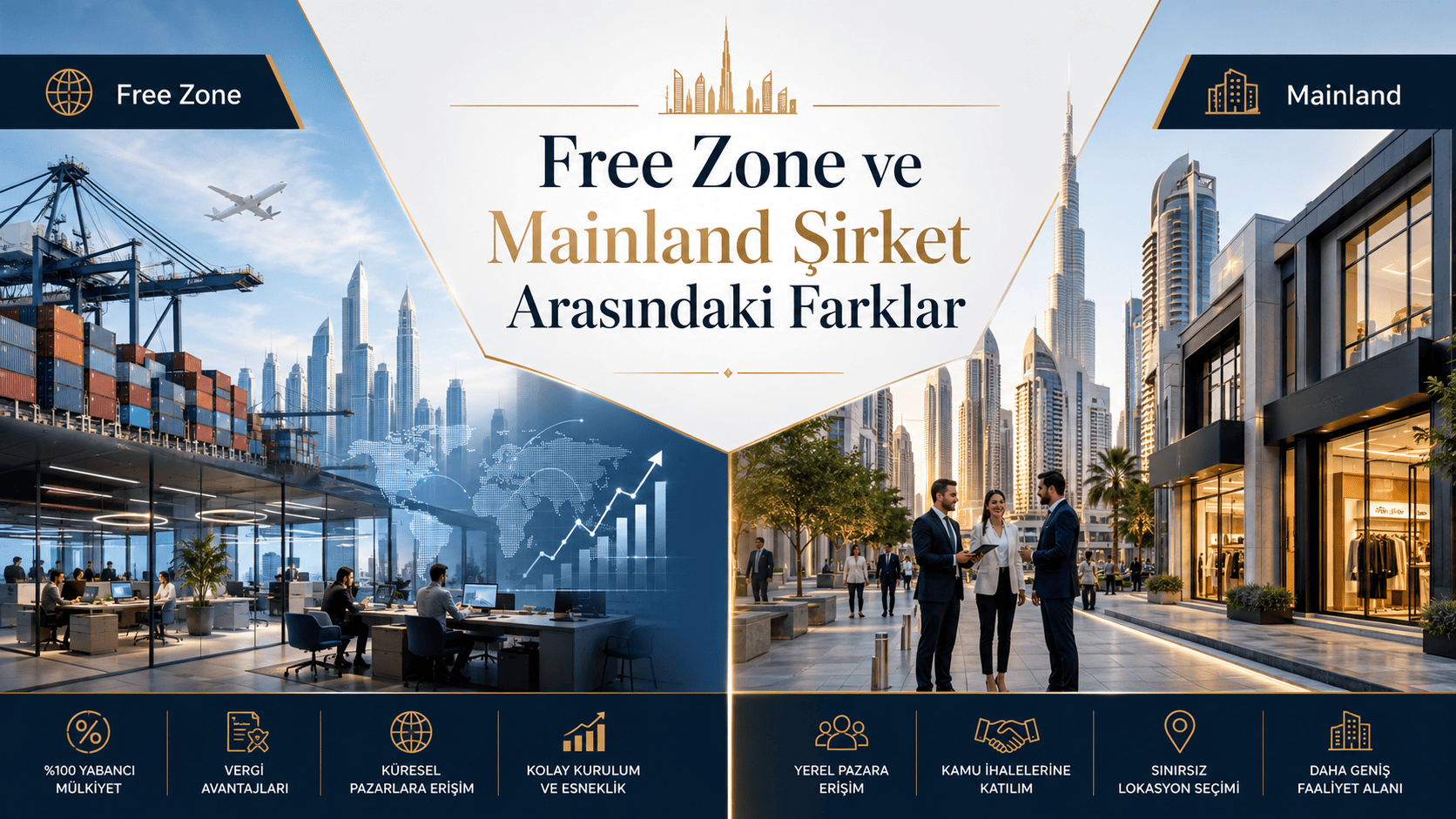
What Are the Differences Between Free Zone and Mainland Companies?
The United Arab Emirates (UAE) has become one of the world’s most attractive business hubs for global entrepreneurs, thanks to its dynamic market, advanced logistics infrastructure, and appealing financial advantages. For entrepreneurs and companies seeking to operate in this strategic gateway connecting the Middle East, Asia, Europe, and Africa, the first and most critical decision is choosing the right company structure: Free Zone or Mainland?
The distinction between these two company structures directly affects the future of your business, from ownership structure and operational limitations to office requirements, visa quotas, taxation dynamics, and corporate bank account procedures. Choosing the wrong company type may lead to higher costs, operational bottlenecks, and regulatory obstacles.
The comprehensive guide below examines the structural, legal, and financial differences between both models, their advantages, and which structure may be better optimized for specific industries.
What Is a Free Zone Company? Key Dynamics and Structure
A Free Zone is a geographically and administratively designated area within the UAE that operates under specific economic regulations, customs benefits, and independent regulatory authorities. There are more than 40 active Free Zones across the UAE, particularly in Dubai, including IFZA, DMCC, Meydan Free Zone, DAFZA, and JAFZA.
These zones are primarily designed for international trade, cross-border digital services, e-commerce, consultancy, and technology-focused businesses. Each Free Zone has its own independent Free Zone Authority, which directly manages company registration and licensing procedures.
Key Features of Free Zone Companies
- Independent Authority: Licensing and incorporation procedures are handled by the relevant Free Zone Authority rather than through the standard economic authority.
- International Trade Focus: Companies can conduct global trade and provide services to other Free Zone businesses.
- Fast Setup: Incorporation procedures are highly digitalized, while physical presence requirements are generally minimal.
What Is a Mainland Company? The Gateway to the UAE Local Market
A Mainland company is a business licensed directly by the relevant economic authority of the emirate, such as the Department of Economy and Tourism in Dubai, and is generally permitted to operate throughout the UAE local market.
In previous years, establishing a Mainland company often required a UAE national to hold a 51% ownership stake. However, reforms introduced under the Commercial Companies Law in 2021 made 100% foreign ownership possible across more than 1,000 commercial and industrial activities.
Key Features of Mainland Companies
- Direct Local Market Access: Mainland companies can directly invoice and conduct business with end consumers and local companies throughout the UAE.
- Flexible Office Locations: Businesses may establish their headquarters or branches in commercial districts, office towers, or industrial areas throughout the UAE.
- Government Tender Participation: Mainland companies may participate in government contracts, semi-government projects, and large public-sector tenders as contractors or subcontractors.
Free Zone vs Mainland Company Differences: 7 Key Comparison Points
1. Ownership Structure and Operational Scope
In the past, foreign ownership was one of the biggest differences between Free Zone and Mainland companies. Today, both structures generally allow 100% foreign ownership, except in certain strategic sectors such as defense, oil, and other restricted industries.
The main operational difference now lies in where and how a company may conduct business.
- Free Zone: A Free Zone company can generally trade internationally, operate with customers outside the UAE, and conduct business with other Free Zone entities. However, direct physical product sales into the UAE Mainland market may require a Mainland distributor, customs agent, or another approved structure.
- Mainland: Mainland companies can generally conduct retail, wholesale, e-commerce, and service activities both inside the UAE and internationally without the same geographical limitations.
2. Office and Physical Space Requirements
The scale of your business and your budget play an important role in determining office requirements.
- Free Zone: Many Free Zones offer Flexi-Desk or Smart Desk / Virtual Office solutions without requiring businesses to rent a full physical office. This can significantly reduce initial setup costs for digital agencies, software companies, consultants, and international service providers.
- Mainland: Mainland companies commonly require a physical office or commercial space registered through Ejari or the relevant tenancy registration system. Office size requirements may depend on business activity, licensing conditions, and visa needs.
3. Visa Quotas and UAE Residence Permit Procedures
Establishing a company in the UAE may allow company owners, partners, employees, and eligible family members to apply for residence and employment visas.
- Free Zone: Visa quotas are generally linked to the selected license package or the size of the rented workspace. For example, a standard Flexi-Desk package may include a limited number of visa allocations. Additional visas may require an upgraded package, larger office space, or additional fees.
- Mainland: Visa allocation is commonly connected to office size, business activity, and labor authority approvals. Businesses planning to hire larger teams may therefore find Mainland structures more scalable.
4. Licensing Authorities and Approval Procedures
- Free Zone: Most incorporation procedures are handled through the relevant Free Zone Authority under a one-stop-shop model. Examples include DMCC, Dubai South, DTEC, and other specialized authorities. In many cases, fewer external approvals are required.
- Mainland: The main licensing authority is typically the economic authority of the relevant emirate, such as Dubai Economy and Tourism. Depending on the business activity, additional approvals may also be required from authorities such as Dubai Municipality, Dubai Health Authority, the media regulator, Civil Aviation authorities, or other government bodies.
5. Dubai Tax Advantages and Corporate Tax Compliance
The introduction of the UAE Federal Corporate Tax regime significantly changed the taxation framework for both Free Zone and Mainland companies.
Standard UAE Corporate Tax Structure
- Taxable income up to the applicable threshold may benefit from a 0% corporate tax rate under the general framework.
- Taxable income above the threshold is generally subject to a 9% corporate tax rate.
- Free Zone – Qualifying Free Zone Person (QFZP): Free Zone companies that meet the relevant conditions may continue to benefit from a 0% Corporate Tax rate on Qualifying Income generated from qualifying activities and certain transactions. Income that does not qualify may be subject to the standard corporate tax regime.
- Mainland: Mainland companies are generally subject to the UAE’s standard Corporate Tax system, with the applicable tax treatment determined according to taxable income and prevailing regulations.
Note: Regardless of company type, UAE businesses that exceed the applicable VAT registration threshold may be required to register for the 5% Value Added Tax (VAT) system.
6. Corporate Bank Account Opening Procedures
UAE banks such as Emirates NBD, Mashreq, First Abu Dhabi Bank, and Wio apply strict Anti-Money Laundering (AML) and Know Your Customer (KYC) procedures when opening corporate bank accounts.
- Mainland: Mainland companies may be viewed more favorably by some banks due to physical office presence, local contracts, local invoices, and visible domestic operations. This may make the compliance process more straightforward in certain cases.
- Free Zone: Free Zone companies using shared desks or virtual offices may face more detailed compliance checks. Banks may request evidence of commercial activity, customer contracts, supplier agreements, invoices, source of funds, and proof of genuine business operations.
7. Government Tenders and Public Contracts
- Free Zone: Free Zone companies may face limitations when attempting to participate directly in certain government tenders or strategic-sector projects.
- Mainland: Mainland companies generally have broader access to government tenders, municipality projects, public-private partnerships, and local public-sector contracts, subject to the relevant tender requirements.
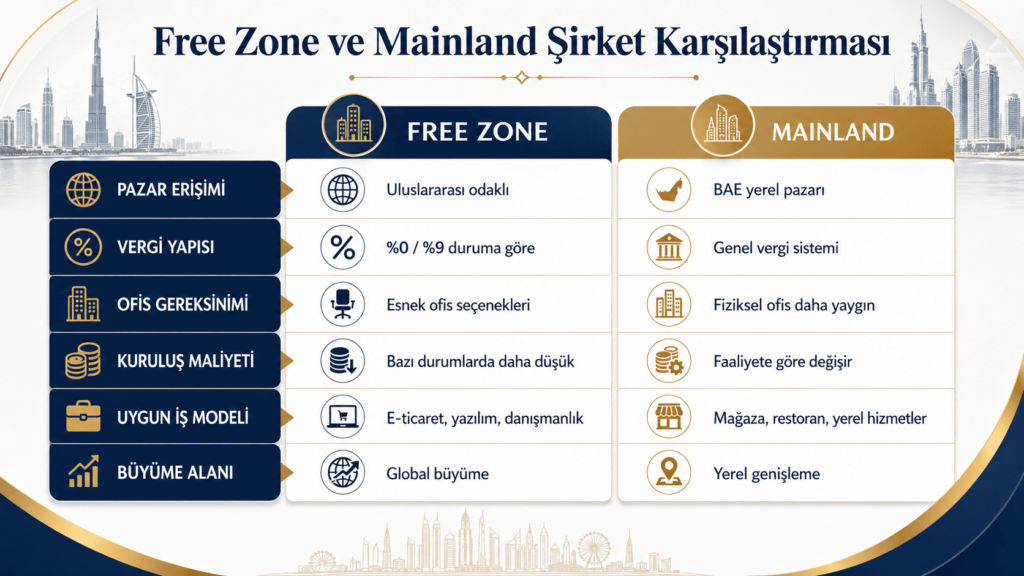
Free Zone vs Mainland Comparison Table
The table below summarizes the main operational differences between the two structures:
| Criteria / Feature | Free Zone Company | Mainland Company |
|---|---|---|
| Foreign Ownership | 100% Foreign Ownership | 100% Foreign Ownership in most permitted activities |
| Licensing Authority | Relevant Free Zone Authority | Relevant Economic Department / Authority |
| UAE Local Trade (B2C/B2B) | May be restricted depending on activity and structure | Broad direct access |
| International Trade | Broad international trade capability | Broad international trade capability |
| Office Requirement | Flexi-Desk / shared office may be sufficient | Physical office often required |
| Corporate Tax | 0% on qualifying income if requirements are met; otherwise standard treatment may apply | Standard UAE Corporate Tax regime |
| Government Tenders | May face limitations | Broader eligibility |
| Bank Account Opening | May involve stricter KYC documentation | Often supported by stronger local operational presence |
| Initial Cost | Low to Medium | Medium to High |
What Are the Advantages of a Free Zone Company? Which Businesses Is It Suitable For?
Establishing a Free Zone company can provide significant flexibility and cost advantages for certain business models.
Main Advantages
- Lower Entry Costs: Since a full physical office may not be mandatory, rental and operational expenses may be significantly reduced.
- Flexible Packages: Free Zones often offer licensing options ranging from zero-visa packages to multi-visa plans.
- Capital and Profit Repatriation: Businesses can generally repatriate capital and profits without local capital restrictions, subject to applicable laws and banking requirements.
- Industry-Specific Ecosystems: Certain Free Zones are built around specific sectors, such as DIFC for finance, Dubai Media City for media, and technology-focused zones for digital and innovation businesses.
Business Models Suitable for Free Zone Companies
- Software, IT, and SaaS Companies: Businesses that provide digital services without requiring physical product distribution.
- International Consultancy and Agencies: Digital marketing, financial consultancy, management consulting, and coaching businesses.
- Cross-Border E-Commerce and Dropshipping: Businesses where products are shipped internationally without entering the UAE local market.
- Holding and Investment Vehicles: Legal entities created to manage global assets, investments, or subsidiaries.
Mainland Company Setup Costs and Opportunities
The Mainland company structure may require a more comprehensive initial investment, but it can be an effective solution for businesses seeking to establish a strong presence in the UAE market.
Cost Components
- Initial Approval and Trade Name Fees: Costs associated with business name registration and initial government approvals.
- License Fees: Commercial, professional, or industrial licensing expenses.
- Physical Office Rent: Annual rent, Ejari registration, and possible security deposits.
- Local Service or Corporate Consultancy Costs: Administrative and legal coordination expenses where applicable.
- Residence Visa Expenses: Medical testing, Emirates ID issuance, immigration procedures, and visa-related fees.
Business Models Suitable for Mainland Companies
- Retail Stores and Restaurants: Businesses offering physical goods, food, or services directly to consumers.
- Local Wholesale and Distribution: Companies distributing goods to supermarkets, retailers, or institutions throughout the UAE.
- Construction, Real Estate, and Contracting: Businesses involved in construction projects, contracting, and real estate services.
- Logistics and Local Transportation: Companies operating domestic transportation, courier, delivery, and logistics networks.
Step-by-Step UAE Company Formation Roadmap
When properly planned, company formation in Dubai and the wider UAE can follow a structured and efficient process.
- Determine the Business Activity: Identify the commercial activities and activity codes that will be included in your license.
- Choose the Company Structure: Decide between Free Zone and Mainland.
- Reserve the Trade Name: Select and reserve a company name in accordance with UAE regulations.
- Obtain Initial Approval and Prepare the MOA: Complete the initial approval process and prepare the Memorandum of Association where required.
- Secure Office Space and Tenancy Registration: Register an office or workspace suitable for the selected company structure.
- Obtain the Trade License: Pay the required government fees and receive the commercial license.
- Complete Establishment Card and Visa Procedures: Register the company with immigration authorities and complete residence visa, medical test, and Emirates ID procedures.
- Open a Corporate Bank Account: Apply for a business bank account with a local or international bank.
Decision Guide: Which Company Model Is Right for You?
To determine which structure is better suited to your business, consider the following:
- If your target audience consists mainly of international customers, you provide digital services, and you are looking for lower entry costs and flexible office requirements, a Free Zone company may be the more suitable option.
- If you want to open a store, restaurant, warehouse, or local office in the UAE, directly invoice UAE customers, participate in government tenders, or build a larger local workforce, a Mainland company may be the better choice.
Both structures form part of the UAE’s strong commercial ecosystem. The key is to ensure that the legal structure you choose aligns closely with your business model, target market, operational requirements, and long-term commercial goals.
